Mar 27, 202613 min read
20 things to know before traveling to India{
"url": "tripping-on-history",
"destination": "India",
"title": "india",
"country": "India",
"continent": "Asia",
"refresh": 30,
"refresh_limit": 3
} For a traveler in pandemic times, road-tripping seems the ultimate way to reclaim their mojo. And for that, Bengaluru is favorably located. It has a diverse set of destinations around it, just a road trip away. Be it the hills, meadows, rocks, rivers, waterfalls, forests, coffee estates, vineyards, forts or temples, a strip of asphalt will lead you to them.
{
  "url": "tripping-on-history",
  "destination": "India",
  "title": "india",
  "country": "India",
  "continent": "Asia",
  "refresh": 30,
  "refresh_limit": 3
} But for this road-tripping, make it two actually, I had my eyes on two temples, one built during the Hoysala times and the other, during the Vijayanagar empire. The temples at Haranahalli and Lepakshi are worthy examples of the style and architecture of the period they represent. Lepakshi is in today’s Andhra Pradesh but is closer to Bengaluru than Haranahalli. One destination is well within the tourist route and the other, off the beaten trail. I will begin with Haranahalli, that has been obscured only because of its famous peers Halebid and Belur.
Haranahalli village, close to the city of Hassan, is where a part of the family line had lived about 250 years ago. The map showing the route has a lot of blues indicating lakes of all sizes, some so vast that they are worthy of a pitstop. Our destination comes around the three-hour mark and though the majority of the trip was on highways, the final leg was on two-carriageway roads that wound past small villages with intriguing names.
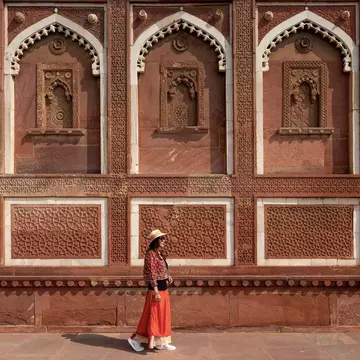
Haranahalli has two Hoysala temples, the Lakshminarasimha Temple and the Somesvara Temple. Both are a stone throw from the village’s only main road but located on either side of it. The unassuming frontage of the Lakshminarasimha Temple and the closed wooden doors don’t quite prepare you for the massive garden in which the squat yet regal temple is standing. Set on a raised star-shaped platform, like most Hoysala temples were, this one is a near intact example of 13th century Hoysala architecture. That means it was built with soapstone, which is softer than granite used for their earlier temples. The outer parakram has stone columns running along the circumference. These have highly intricate carvings in decorative bands and some local kids helpfully point out to the birds (hansas) and fishes (makara) that have caught their fancy. Within, there are three shrines (Lakshminarasimha, Krishna, and Vishnu) that share a common vestibule, mantap, which has gorgeous lathe-turned pillars and a superbly decorated ceiling.
There are carved panels throughout, depicting scenes of the period and the ninth Hoysala king, Vira Someswara, who built the temple. Inscriptions in ‘halle kannada’ appear in panels. The nearby Somesvara Temple was also built to impress but sadly, is locked after the recent theft of the main idol, the centuries old ‘shiv lingam’. Its garden is eerily silent, as though the entire premise is protesting at the great robbery. A quietude settled in and the return trip was spent reflecting upon an Ozymandias past.
{
  "url": "tripping-on-history",
  "destination": "India",
  "title": "india",
  "country": "India",
  "continent": "Asia",
  "refresh": 30,
  "refresh_limit": 3
} Getting there:
Distance: 173 kms
Time: 3 hrs 50 mins
Route: NH 75 via Channarayapattana on Shivamogga Road (tolls)
My interest for Lepakshi was fanned when I had visited the ICKPAC office at the basement of Chitrakala Parishath, Bengaluru’s premium art school. The INTACH Chitrakala Parishath Art Conservation Centre’s then director, Madhu Rani, had told me about their meticulous conservation of the ceiling paintings at the 16th century Virabhadra Temple in Lepakshi. These have been celebrated by historians as the most extensive and best-preserved examples of pictorial art from the Vijayanagara period. That was the trigger for a visit but for the intrepid traveler, it is serendipity that awaits.
A fairly dull two-hour drive gets you to Lepakshi without fanfare. Virabhadra Temple aka Lepakshi Temple stands out for its grand architecture. The temple complex seems to have been built on a single rock. The main temple has shrines of Virabhadra, Shiva, Vishnu, and others where daily worship happens. The colonnaded ranga mandapa or the dance hall has intricate sculptures on every stone pillar. Beside the temple is a 12-foot high monolithic shiva lingam sheltered by a large fan-like hood of a snake. Local stories speak of the sculptors waiting for their mother to cook food and decided to do the sculpture meantime. A crack appeared and the lingam was not worshipped but is admired. It is in the main temple that a ‘floating pillar’ rests where guides whip out their handkerchiefs and pass it below the base.
The famous paintings, however, adorn the ceilings and walls of many parts of the temple, including the mahamandapa, in long panels. The clothes of the era – men wore conical hats or kulave, women wore sarees with stripes and checks – can be seen in detail. The Lepakshi sarees get their designs from the columns here and the ones in the unfinished marriage hall. The stunning craftsmanship within the temple is replicated in the 15-feet high monolithic Nandi nearby. Lepakshi has beauty, lore and enigma (giant footprints in a rock where water wells up!) and it is up to the traveler to bring back the stories.
Getting there:
{
  "url": "tripping-on-history",
  "destination": "India",
  "title": "india",
  "country": "India",
  "continent": "Asia",
  "refresh": 30,
  "refresh_limit": 3
} Distance: 123 kms
Time: 2 hrs 20 mins
Route: NH 44 via Devanahalli (tolls)
You may also like
{
  "url": "tripping-on-history",
  "destination": "India",
  "title": "india",
  "country": "India",
  "continent": "Asia",
  "refresh": 30,
  "refresh_limit": 3
} Lonely Planet Journeys takes you there with fully customizable trips to top destinations – all crafted by our local experts.