A medieval mosque with a Christian cathedral set inside it, Córdoba’s Mezquita is one of the world's greatest works of Islamic architecture. It was originally built in the 8th century but enlargements over the next couple of centuries saw it become one of the largest and most architecturally sophisticated mosques of its age. Some five centuries on and it remains an astonishing sight with its serene columned interior, lustrous decoration and extraordinary mihrab (prayer niche).
The history of worship on the site actually predates the Mezquita, going back to the mid-6th century when a small Visigoth church, the Basilica of San Vincente, stood here. Arab chronicles recount how Abd ar-Rahman I purchased half of the church for the Muslim community’s Friday prayers, and then, in 784 CE, bought the other half as a site for a new mosque. His original structure, built between 786 and 788, subsequently underwent three extensions, increasing its size fivefold and bringing it to the form you see today – with one major alteration: a Christian cathedral was added to the middle of the mosque in the 16th century (hence the often-used description "Mezquita-Catedral").
Patio de los Naranjos
This lovely courtyard, with its orange, palm and cypress trees and fountains, was the site of ritual ablutions before prayers in the mosque. There are several entrances (it's free to go in and have a look around), the most impressive of which is the Puerta del Perdón, a 14th-century Mudéjar archway next to the bell tower. The Mezquita's ticket offices are just inside here.
Bell Tower (Torre Campanario)
You can climb the 54m-high bell tower for fine panoramas and an interesting bird's-eye angle on the main Mezquita building. Originally built in 951–52 as the Mezquita's minaret, the torre was encased in a strengthened outer shell and heightened by the Christians in the 16th and 17th centuries. You can still see some caliphal vaults and arches inside. The original minaret, which would have looked very similar to Seville's Giralda, influenced all minarets subsequently built in the western Islamic world.
Up to 20 people are allowed up the tower every half hour between 9.30am and 6.30pm from March to October (to 5.30pm November to February, to 2.30pm July and August). Note, however, that there are no admissions at 11.30am and 1pm on Sundays. Tickets (€2) are sold at the ticket offices near the tower: they often sell out well ahead of visit times, so it's worth buying early in the day.
Interior
Though stunning from the outside, it's only by stepping into the Mezquita's mind-blowing interior that you get the full measure of its beauty. To help you navigate, there are free leaflets available just inside the visitor entrance.
The Mezquita’s architectural importance lies in the fact that, structurally speaking, it was a revolutionary building for its time. Earlier Islamic buildings such as the Dome of the Rock in Jerusalem and the Great Mosque in Damascus placed an emphasis on verticality, but the Mezquita was intended as a simple, democratically horizontal space, where the spirit could roam freely and communicate with God – a kind of glorious refinement of the original Islamic prayer space (usually the open yard of a desert home).
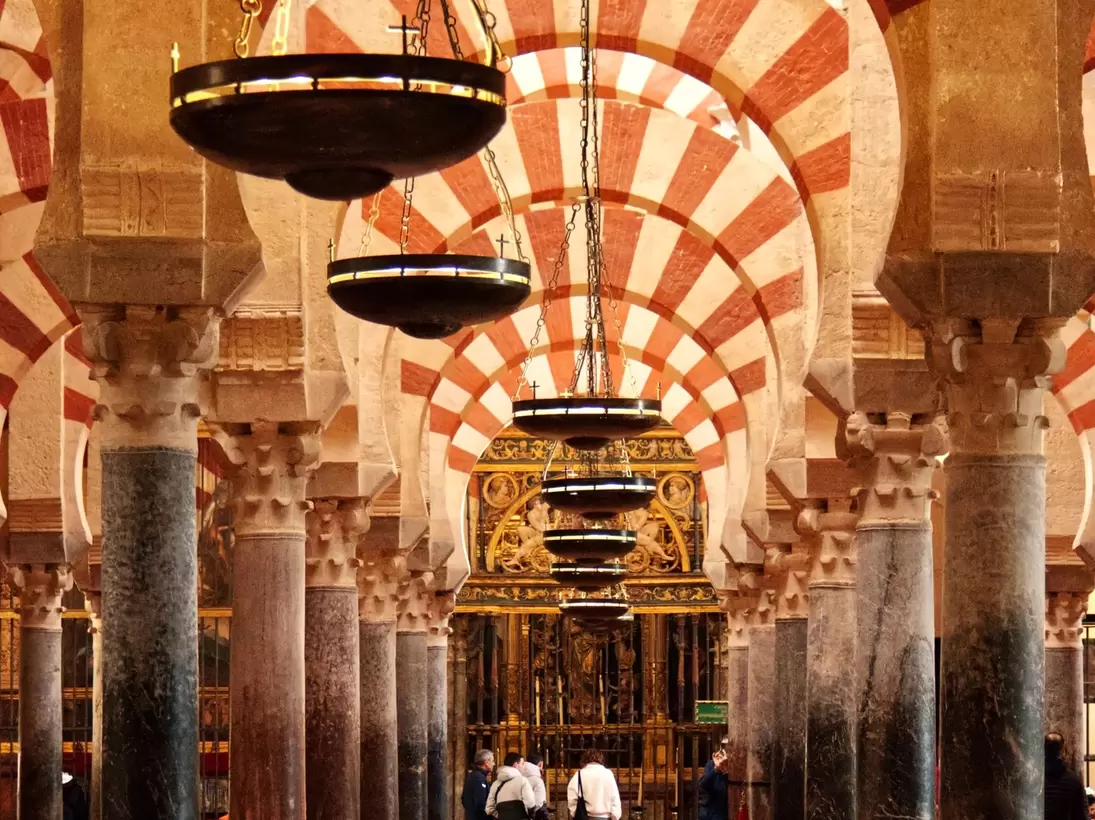
Men prayed side by side on the argamasa, a floor made of compacted, reddish slaked lime and sand. The flat roof, decorated with gold and multicoloured motifs, was supported by striped arches suggestive of a forest of date palms. The arches rested on, eventually, 1293 columns (of which 856 remain today).
Abd ar-Rahman I’s initial prayer hall – the area immediately inside the entrance – was divided into 11 "naves" by lines of arches striped in red brick and white stone. The columns of these arches were a mishmash of material collected from the earlier church on the site, Córdoba’s Roman buildings and places as far away as Constantinople. To raise the ceiling high enough to create a sense of openness, inventive builders came up with the idea of a two-tier construction, using taller columns as a base and planting shorter ones on top.
Later enlargements, southward by Abd ar-Rahman II in the 9th century and Al-Hakim II in the 960s, and eastward by Al-Mansur in the 970s, extended the mosque to an area of nearly 14,400 sq meters, making it one of the largest mosques in the world.
The final Mezquita had 19 doors along its north side, filling it with light and creating a sense of openness. Most of these doorways have since been closed off, dampening the vibrant effect of the red-and-white double arches. Christian additions to the building, such as the cathedral and the many chapels around the fringes, further enclose the airy space.
Mihrab & Maksura
In the southern wall, opposite the visitor entrance, the mihrab (prayer niche) and maksura (royal prayer enclosure) are the Mezquita's decorative highlights. They were both created as part of an extension commissioned by Al-Hakim II in the 960s. The naves of the prayer hall were lengthened and a new qiblah wall (indicating the direction of Mecca) and mihrab were added.The bay in front of the mihrab and the bays to each side of it form the maksura, the area where the caliphs and courtiers would have prayed.
Particularly spectacular is the mihrab's portal – a crescent arch with a rectangular surround known as an alfiz. To decorate this, Al-Hakim asked the emperor of Byzantium, Nicephoras II Phocas, to send him a craftsman capable of imitating the mosaics of the Great Mosque of Damascus, one of the great Syrian Umayyad buildings. In response, the Christian emperor sent a mosaicist along with 1600kg of gold mosaic cubes. And it's this gold, shaped into unbelievably intricate flower motifs and inscriptions from the Quran, that gives the portal its magical glitter. Inside the mihrab, a single block of white marble sculpted into the shape of a scallop shell, a symbol of the Quran, forms the dome that once amplified the voice of the imam throughout the mosque.
The arches of the maksura are the mosque’s most intricate and sophisticated, forming a forest of interwoven horseshoe shapes. Above them the maksura’s sky-lit domes are a spellbinding sight, with their star-patterned stone vaulting. Each dome is held up by four interlocking pairs of parallel ribs, a highly advanced technique for 10th-century Europe.
Cathedral
Following the Christian conquest of Córdoba in 1236, the Mezquita was used as a cathedral but remained largely unaltered for nearly three centuries. However, in the 16th century King Carlos I gave the cathedral authorities permission to construct a new Capilla Mayor (main altar area) and coro (choir) in the center of the Mezquita.
Legend has it that when the king saw the results of the work he was horrified, exclaiming that the builders had destroyed something unique in the world. The church, which is still today Córdoba's official cathedral, took nearly 250 years to complete (1523–1766) and exhibits a range of architectural styles, from Gothic and plateresque to late Renaissance and Spanish baroque. Among its standout features are the Capilla Mayor's rich 17th-century jasper and red-marble retable (altar screen), and the fine mahogany stalls in the choir, carved in the 18th century by Pedro Duque Cornejo. Capping everything is a towering 16th-century dome.
Night Visits
A one-hour sound-and-light show ("El Alma de Córdoba"), in nine languages via audio guides, is presented in the Mezquita twice nightly except Sundays from March to October, and on Fridays and Saturdays between November and February. Tickets are €18 (senior or student €9). Further details are available on the website.