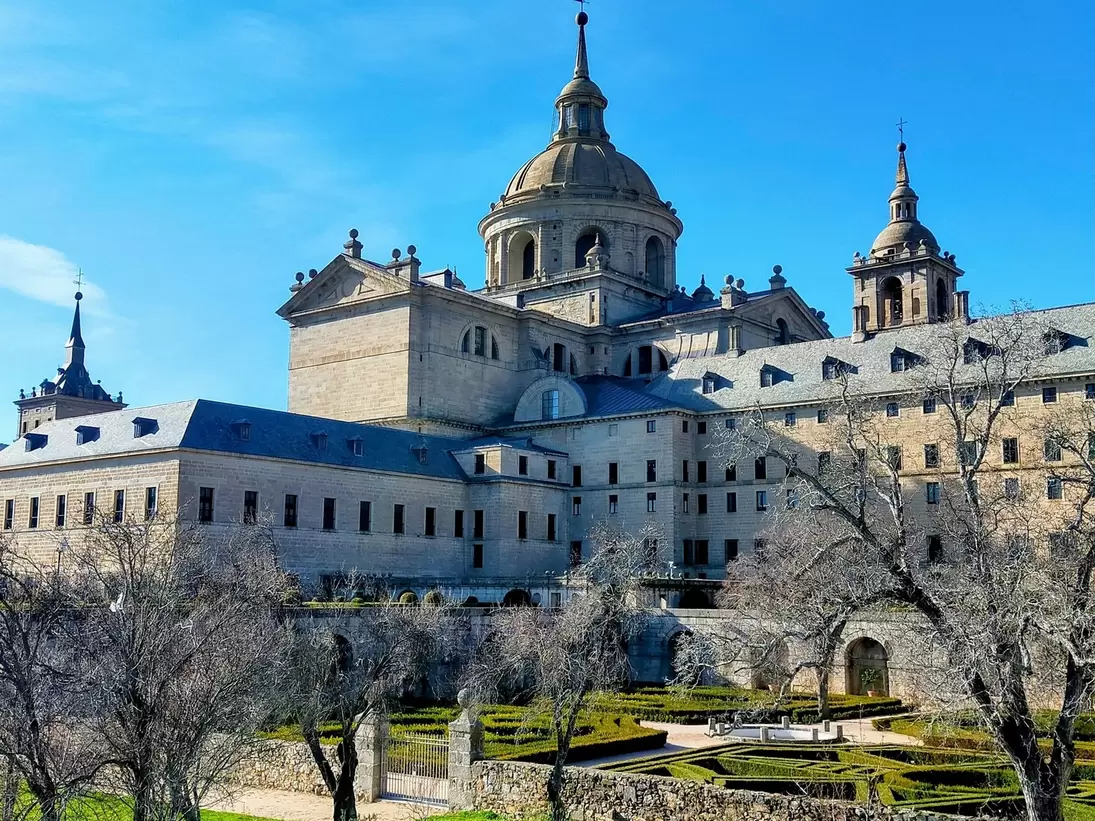
Home to the majestic monastery and palace complex of Real Monasterio de San Lorenzo, the one-time royal getaway of San Lorenzo de El Escorial rises up from the foothills of the mountains that shelter Madrid from the north and west. Although it attracts its fair share of foreign tourists, this prim little town and its fresh, cool air has been drawing city dwellers here since the complex was built on the orders of King Felipe II in the 16th century.
The monastery's main entrance is on its west side. Above the gateway a statue of St Lawrence stands watch, holding a symbolic gridiron, the instrument of his martyrdom (he was roasted alive on one). From here you'll first enter the Patio de los Reyes (Patio of the Kings), which houses the statues of the six kings of Judah. Overlooking this courtyard, up a narrow flight of stairs, is Felipe II’s incredible biblioteca (library) which houses a gorgeous collection of ancient tomes.
On the opposite side of Patio de los Reyes is the somber basilica. As you enter, look up at the unusual flat vaulting by the choir stalls. Once inside the church proper, turn left to view Benvenuto Cellini's white Carrara marble statue of Christ crucified (1576). Behind the altar, a marble tabernacle designed by head architect Juan de Herrera adds to the frosty splendor of a space that shows the spiritual side of Felipe II.
The remains of Felipe lie below ground in the 17th-century Panteón de los Reyes (Crypt of the Kings), where almost all Spain's monarchs since Carlos I are interred in marble tombs. For a bit of relief from the funereal gloom take the stairs up from the Patio de los Evangelistas (Patio of the Gospels) to the Salas Capitulares (Chapter Houses) in the southeastern corner of the monastery. These bright, airy rooms, with richly frescoed ceilings, contain a minor treasure chest of works by El Greco, Titian, Tintoretto, José de Ribera and Hieronymus Bosch (known as El Bosco to Spaniards).
Another artwork not to be missed is the enormous mural in the Sala de Batallas, which stretches the length of an entire gallery and depicts various Spanish military victories. Upstairs is the sumptuous Palacio de los Borbones. Its over-the-top decor replete with tapestries and chandeliers makes a striking contrast to the rest of the palace.
Just south of the monastery is the Huerta de los Frailes garden. To the east is the Jardín del Príncipe, a lovely monumental garden which leads down to the town of El Escorial (and the train station), and contains the Casita del Príncipe, a little neoclassical gem built in 1772 by Juan de Villanueva under Carlos III for his heir, Carlos IV.