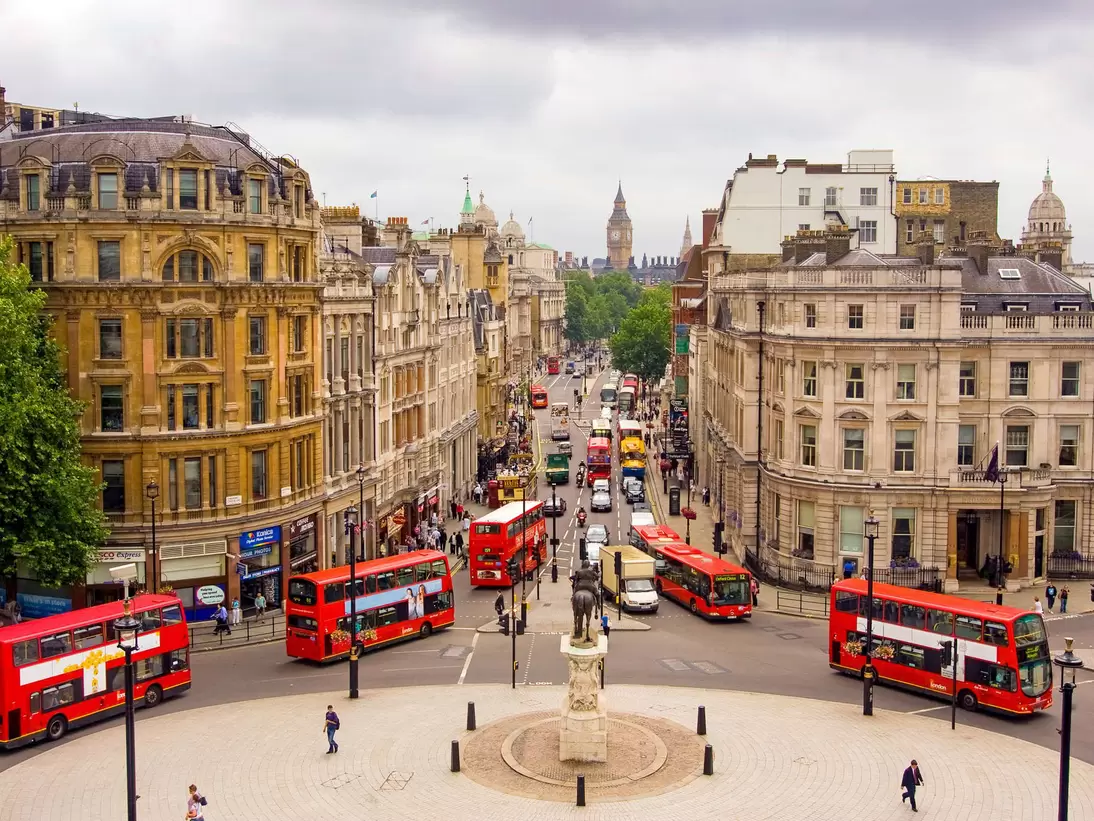
Opened to the public in 1844, Trafalgar Sq is the true center of London, where rallies and marches take place, tens of thousands of revellers usher in the New Year and locals congregate for anything from communal open-air cinema and Christmas celebrations to political protests. It is dominated by the 52m-high Nelson's Column, guarded by four bronze lion statues, and ringed by many splendid buildings, including the National Gallery and the church of St Martin-in-the-Fields.
Three of the four plinths at Trafalgar Sq’s corners are occupied by notables: King George IV on horseback, and military men General Sir Charles James Napier and Major General Sir Henry Havelock. The Fourth Plinth, originally intended for a statue of King William IV, remained empty for 150 years because of a lack of funds.
Since 1999 the fourth plinth has been the stage for modern sculpture; each remains in place for 18 months. In September 2022, Antelope by Samson Kambalu took over the space: the statue is a sculpted version of a 1914 photograph of preacher and pan-Africanist John Chilembwe and European missionary John Chorley. Chilembwe is displayed with his hat on, defying the colonial rule that forbade Africans to wear hats in front of white people; he's also much larger than Chorley, a way for Kambalu to elevate Chilembwe's story and that of other underrepresented people during colonial rule.
Nearby, the much-overlooked, if not quite ignored, brass plaques recording the precise length of imperial units – including the inch, foot and yard – are set into the stonework to the left of the steps as you walk down from the National Gallery. All distances to London are measured from another plaque at the foot of the statue of King Charles II on horseback, located on a traffic island south of Nelson's Column.
Fountains were included in the square's designs to reduce the number of people who gather in the area and to deter riots. If anything got out of hand, a small police box with a direct line to Scotland Yard and narrow windows to view the whole square was built in the southeast corner and is often called London's smallest police station.